At Bay Radiology, breast imaging is not just about doing the standard exam and stopping there. It is about giving women in our area access to newer tools that can help catch breast cancer earlier and answer harder questions when regular mammography does not tell the whole story.
Contrast-enhanced mammography is one of those tools. By using contrast during the exam, it gives radiologists another way to evaluate breast tissue, not just by how it looks on an image, but by how it responds. That can make a real difference in situations where standard imaging leaves uncertainty.
And because this technology is available here in Panama City, women do not have to leave the area to access a more advanced level of Breast Imaging.
What Is Contrast-Enhanced Mammography?
A contrast-enhanced mammogram builds on a standard mammogram by adding one key step before Imaging begins. A contrast agent is given through a small IV, which travels through the bloodstream and interacts differently with certain types of tissue.
This allows the exam to show more than structure alone. In addition to the usual images, radiologists can see patterns of activity within the breast, including areas where blood flow is increased. These patterns can help bring attention to findings that might otherwise be difficult to fully evaluate on standard or even 3D mammography.
When Contrast-Enhanced Mammography May Be Recommended
Some of the most common reasons contrast-enhanced mammography may be recommended include:
- Follow-up after a mammogram when an area cannot be fully explained with standard or 3D imaging
- Evaluating the extent of a known breast cancer, including how much of the breast is involved
- Breast symptoms, such as a lump, nipple discharge, or skin changes that need further evaluation
- Higher-risk patients who may need more than routine screening alone
- Patients with dense breast tissue, where additional imaging may be helpful as part of the overall evaluation
Why This Technology Matters
Contrast-enhanced mammography can be especially valuable in situations where other imaging options have limits.

Less Affected by Dense Breast Tissue
On a standard mammogram, both dense breast tissue and certain abnormalities can appear white. That can make it harder to tell one from the other. Contrast-enhanced mammography helps separate these patterns, which can make certain findings easier to evaluate.
An Option When MRI is Not Ideal
Breast MRI is often used for more detailed evaluation, but it is not always the right fit for every patient. Some people cannot tolerate MRI due to claustrophobia, implanted devices, or reactions to MRI contrast. Contrast-enhanced mammography offers another option in these situations.
Faster and More Accessible Than MRI
Compared to MRI, contrast-enhanced mammography is typically a shorter exam and more widely available. For many patients, it is also a more practical experience while still providing valuable diagnostic information.
What to Expect During Your Appointment
A contrast-enhanced mammogram is similar to a standard mammogram, but there are a few additional steps at the beginning of your visit.
Before the imaging starts, a small IV will be placed so the contrast can be given. After the injection, your care team may have you wait briefly to make sure you feel well before moving forward with the exam.
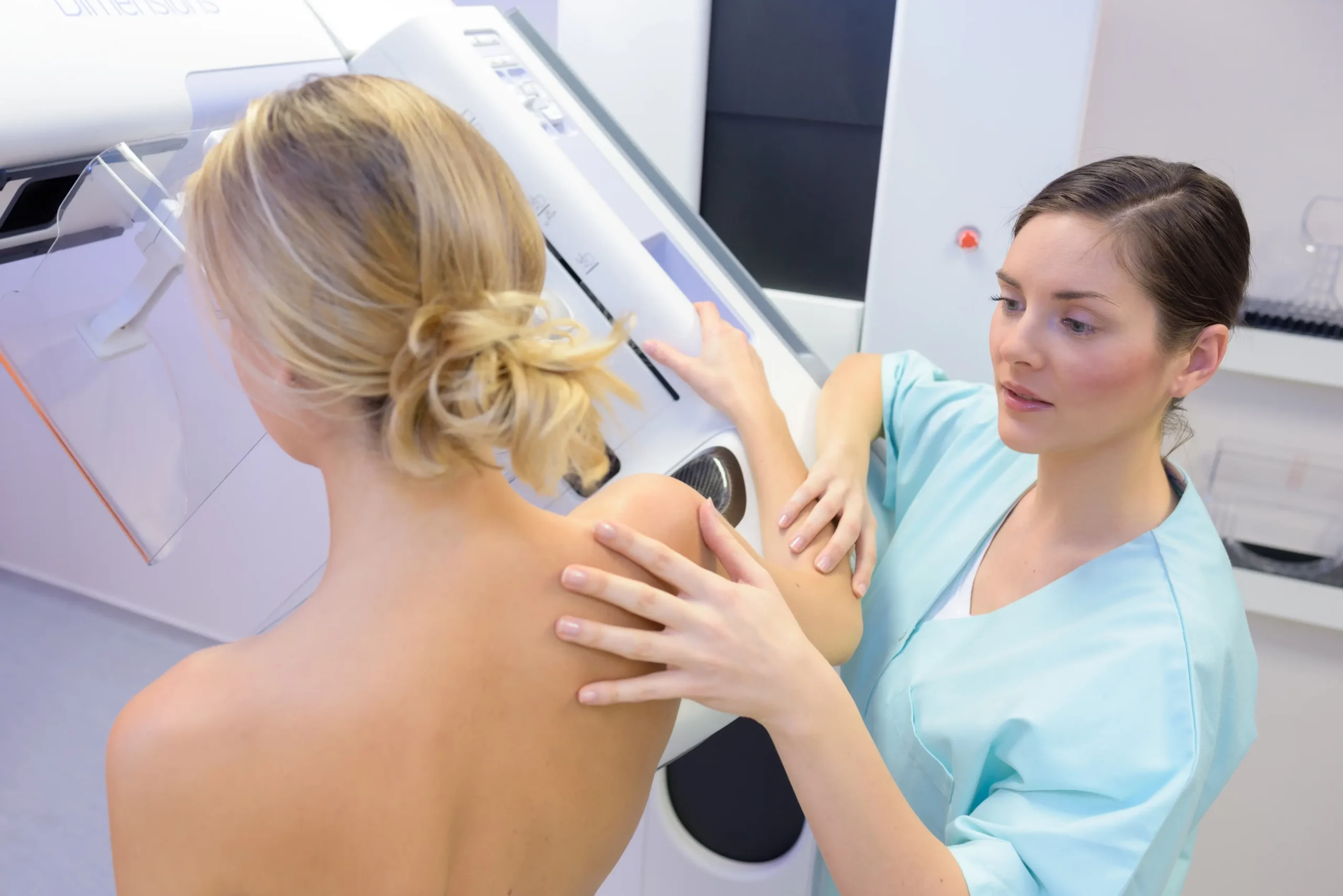
Once imaging begins, the experience is much like a regular mammogram. The positioning and compression are the same, and the images are taken in a similar way.
Because of the IV and preparation time, your appointment will take a little longer than a standard mammogram.
How to Prepare
Preparing for a contrast-enhanced mammogram is mostly similar to preparing for a regular mammogram, with a few added considerations because contrast is involved.
Before the exam, your care team may ask about allergies, past reactions to contrast, and certain health conditions that could affect whether contrast is right for you. In some cases, they may also need information about kidney function before the study.
Otherwise, the preparation is usually much the same as a standard mammogram. If there is anything specific you need to do before your appointment, your care team will let you know ahead of time.
Results and Next Steps
After your exam, the images are reviewed at Bay Radiology by Board Certified, Fellowship Trained radiologists with expertise in Breast Imaging. This review includes both the mammogram images and the contrast-enhanced portion of the study, which helps provide a more complete picture of what is happening in the breast.
Your results are then sent to the provider who ordered the exam. From there, your provider will talk with you about what the findings mean and whether any follow-up is recommended.
Frequently Asked Questions
How long has contrast-enhanced mammography been used?
Contrast-enhanced mammography is a newer advancement compared to standard mammography, but it has been in use for several years and continues to gain adoption as more practices add it to their Breast Imaging services.
It was developed to help fill a gap between standard mammography and breast MRI, giving radiologists another option when additional information is needed.
How long does a contrast-enhanced mammogram take?
A contrast-enhanced mammogram usually takes a little longer than a standard mammogram. The imaging itself is similar in length, but extra time is needed at the beginning of the appointment for the IV and contrast injection.
In most cases, you can expect the full visit to take a bit longer than a typical mammogram, often around 30 minutes more, depending on the situation.
Is a contrast-enhanced mammogram worth it?
For some patients, it can be very helpful. This type of imaging is typically recommended when standard or 3D mammography does not provide enough information or when a more detailed evaluation is needed.
It is not used for everyone, but in the right situation, it can help your care team better understand a finding and decide what to do next. Your provider can help determine whether it makes sense for your specific case.
Is contrast-enhanced mammography covered by insurance?
Coverage can vary depending on your insurance plan and the reason the exam is being performed. In many cases, it may be covered when it is used for diagnostic purposes, but it is always a good idea to confirm with your insurance provider ahead of time.
If you have questions, your care team can also help you understand what to expect before your appointment.
Is contrast-enhanced mammography better than MRI?
These two tests are not direct replacements for each other, but they can serve similar purposes in certain situations.
Breast MRI is still an important tool, especially for high-risk screening and more comprehensive evaluation. However, contrast-enhanced mammography can be a useful alternative for patients who cannot tolerate MRI or when MRI is not the best fit.
The right choice depends on your situation, your history, and your provider’s recommendation.
What is the difference between a mammogram and a contrast-enhanced mammogram?
A standard mammogram shows the structure of breast tissue using X-ray imaging. A contrast-enhanced mammogram includes the same imaging, but adds contrast beforehand to highlight areas of increased activity within the breast.
This allows radiologists to evaluate not just how tissue looks, but also how it behaves, which can provide additional insight in certain situations.
Have Questions Before Your Appointment?
From contrast safety to what to expect during the exam, Bay Radiology can help you feel more informed before your visit.